
Castor Oil Benefits: An Honest Guide to Hair, Skin, Lashes, and Castor Oil Packs
A naturopathic doctor's guide to castor oil benefits: what ricinoleic acid actually does for hair, brows, lashes, and skin, how to use packs, and what the evidence really says.
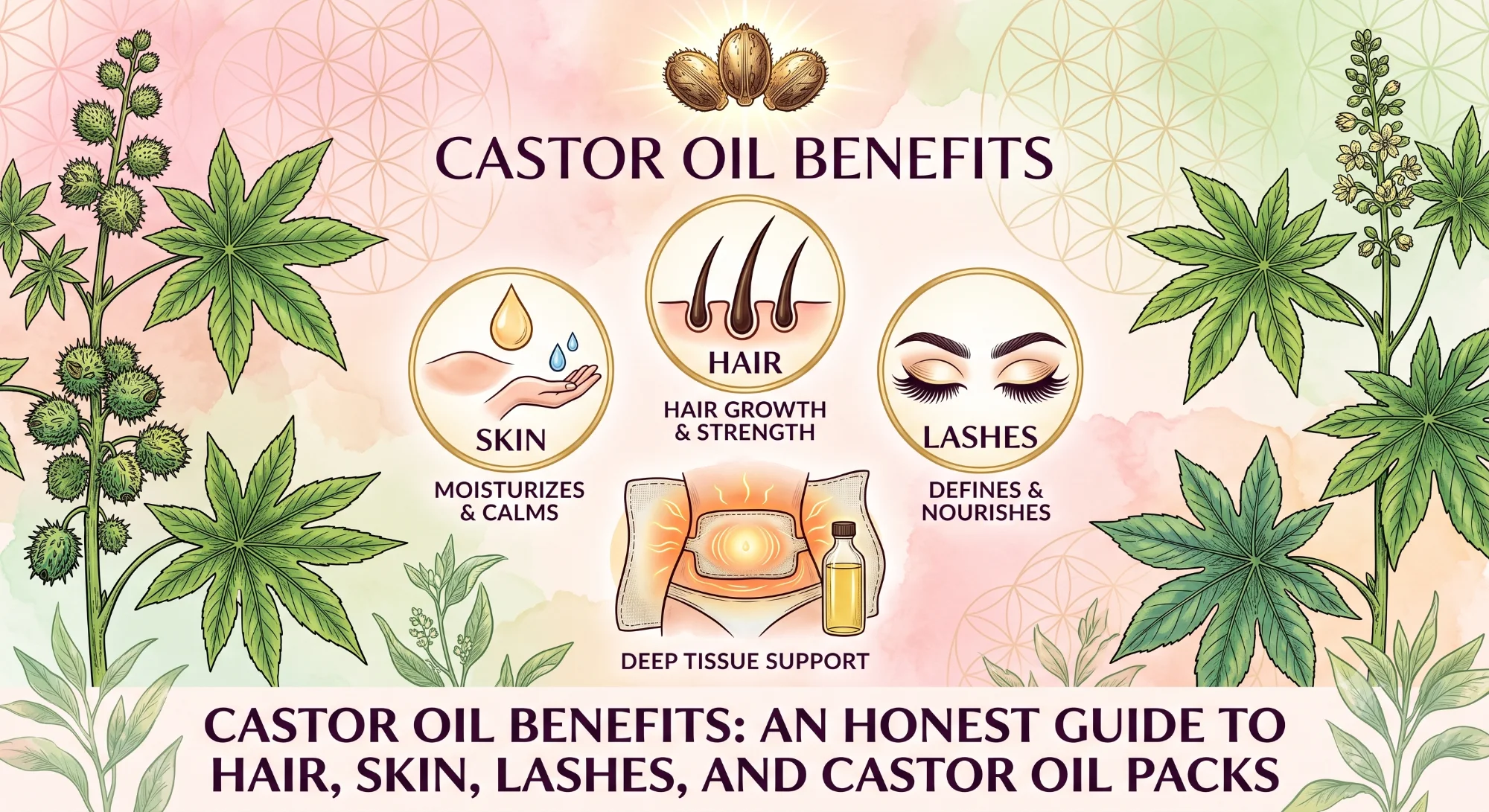
Castor oil is having a moment. It's on every beauty shelf, in every "things my grandmother was right about" video, and somewhere in the back of your bathroom cabinet if your family is anything like ours. But the internet has done this humble oil a disservice. Half of it oversells castor oil as a miracle, the other half waves it off as folklore, and both are missing the actual story: castor oil is one of the better-understood plant oils on the shelf, and the chemistry is genuinely interesting.
So let's do this properly. Here's what castor oil is, what makes it chemically unusual, what the research on its main compound shows, and exactly how to use it without wasting your time or irritating your skin.
What Is Castor Oil, Really?
Castor oil is pressed from the seed of Ricinus communis, the castor plant. The seeds are often called castor beans, though they're not beans at all. The good stuff is cold-pressed, meaning the oil is extracted mechanically without heat or chemical solvents, which preserves more of what makes it worth using in the first place.
It's a thick, slow, honey-colored oil with a faintly nutty smell. It has been used across the world for a very long time: in Ayurvedic practice, in ancient Egypt (castor oil turns up in the Ebers Papyrus, one of the oldest medical texts we have), and in Caribbean traditions where black castor oil remains a staple of hair care passed down through generations. Tradition isn't proof of anything. But in castor oil's case, the chemistry eventually caught up and explained why so many unconnected cultures reached for the same seed.
Why Ricinoleic Acid Makes It Unusual
Here's the part that actually matters, and the reason castor oil behaves differently from the coconut, jojoba, or almond oil sitting next to it.
Roughly 90% of castor oil is ricinoleic acid, a fatty acid that's genuinely rare in the plant world. Most oils are a mixed bag of several fatty acids in modest proportions. Castor oil is overwhelmingly one thing, and that one thing carries an extra hydroxyl group on its fatty acid chain. That single structural quirk—one small addition to the molecule—drives nearly everything castor oil does.
The physical properties:
- It's occlusive and humectant at once. It forms a barrier that slows water loss from the skin while also drawing moisture toward it. Very few oils do both.
- It penetrates rather than sits. Because of that molecular structure, it moves into the skin more readily than its thickness would suggest.
The biological activity, which is the part most articles skip entirely:
- Ricinoleic acid has documented anti-inflammatory activity. This is castor oil's best-established property, not a fringe claim. The mechanism is reasonably well mapped: ricinoleic acid acts on a prostaglandin receptor (EP3) found on smooth muscle and on the sensory nerve endings in your skin. Prostaglandins are the body's local "something is wrong here" messengers, the molecules that switch on redness, swelling, and heat. Ricinoleic acid interferes with that signalling right where it's applied, which is why skin treated with it tends to settle rather than flare. Research comparing it to capsaicin found a similar anti-inflammatory profile without capsaicin's burn.
- Ricinoleic acid has documented antimicrobial activity. It shows measurable activity against a range of bacteria and fungi in laboratory testing. This isn't obscure, either: undecylenic acid, a compound derived from castor oil, has been the active ingredient in over-the-counter antifungal preparations for decades.
- Ricinoleic acid has documented analgesic activity. Same receptor, different tissue. Acting on those sensory nerve endings dulls local pain signalling, which goes a long way toward explaining why castor oil has been rubbed into aching joints for several thousand years.
One distinction we want to be precise about: all of the above is ingredient science. It describes what a molecule does, and it's true. It doesn't make a bottle of oil a medicine, and we won't tell you our roller treats anything. It does mean that when castor oil soothes a rough winter patch on your knuckles, there's a real mechanism underneath, not just a nice feeling and a good story.
We'll name one more use up front: in naturopathic practice, castor oil on the skin is used to support lymphatic flow and the body's natural elimination pathways. That one comes from clinical tradition rather than the lab bench, and it's the reasoning behind the castor oil pack. More on those below.
This is why we built our entire product line on an organic cold-pressed castor oil base rather than the fractionated coconut oil that most roller blends use. The base isn't filler. It's doing work.
Castor Oil for Hair, Brows, and Lashes
This is the most searched use, and castor oil does real work here.
It coats the hair shaft, reduces breakage, and adds genuine slip and shine. Hair that breaks less looks like hair that grows more, and for most people that's the visible win. It also conditions the scalp, and that matters more than it sounds: ricinoleic acid's anti-inflammatory and antimicrobial activity suits a scalp that's dry, flaky, or irritated, and a calm scalp is a better growing environment than an angry one. Apply it weekly and you can expect softer hair that's less prone to snapping at the ends.
Now the honest boundary. Castor oil does not grow new hair from dormant follicles. There's no solid clinical evidence that it increases hair growth rate or reverses hair loss, and you deserve to hear that plainly rather than discover it in month four. The dramatic before-and-after photos are almost always length retention, meaning less breakage, rather than new growth. That's still a genuinely good outcome. It's just a different one, and knowing which one you're buying matters.
How to use it on your scalp and hair:
- Warm a small amount between your palms. Castor oil is thick, so many people cut it 50/50 with a lighter oil like jojoba or coconut for easier spreading.
- Massage into the scalp with your fingertips for three to five minutes. The massage matters as much as the oil.
- Work the remainder through the mid-lengths and ends.
- Leave for thirty minutes to a few hours, then shampoo out. It may take two washes.
- Once or twice a week is plenty.
For brows and lashes: use a clean spoolie or a clean fingertip and apply the tiniest amount along the brow and the lash line at night. Do not put oil directly in your eye. Castor oil conditions the lashes and brow hairs you already have, which means less brittleness and a fuller look over a few weeks. It won't sprout new ones. Overapplying near the eyes is the fastest route to puffiness, and anyone with contact lenses, styes, or sensitive eyes should check with an eye care professional first.
Results at the brow and lash line take six to twelve weeks and are subtle. Anyone promising you more in two weeks is selling something.
Castor Oil for Skin
This is where castor oil is uncomplicatedly good.
As a moisturizer it's excellent for dry patches, cracked heels, chapped lips, dry cuticles, and rough elbows. That dual moisture-binding and moisture-sealing quality means a very small amount goes a long way. It's also a legitimately soothing oil on skin that feels irritated or itchy, and that's the ricinoleic acid doing exactly what the research says it does: quieting the local inflammatory signalling that makes a patch of skin red, tight, and cross with you.
A few practical notes:
- Less is more. A drop or two per area. Castor oil is heavy, and too much just feels sticky.
- Patch test first, especially if you have sensitive skin. Try it on your inner forearm for 24 hours before putting it on your face.
- If you're acne-prone, go slowly. Some people find castor oil beautifully balancing; others find it too rich around the T-zone. Both are normal. Your skin gets a vote.
- Cleansing oil works nicely. Blend one part castor oil with two or three parts of a lighter oil, massage onto dry skin, and remove with a warm cloth.
Dr. Mansi's take: I keep castor oil in my bag for the least glamorous reasons. Dry cuticles, a cracked heel, the patch of skin on my knuckles that splits every winter. My honest advice is to use far less than you think and give it four weeks before you judge it. Castor oil rewards consistency, not enthusiasm.
Castor Oil Packs for Gut Health: Bloating, Sluggish Digestion, and Constipation
The castor oil pack is an old naturopathic practice, and it's had a genuine resurgence. A pack is castor oil applied to a cloth, placed on the skin, covered, and left in place with gentle warmth for an hour or so. It's traditionally placed over the abdomen and the liver area to support the body's natural detoxification and elimination pathways.
Start with the pharmacology, because castor oil's relationship with the gut is the best-mapped thing about this entire plant.
Ricinoleic acid and your intestines speak the same language. Castor oil's effect on gut motility has been known for about as long as anyone has been writing medicine down, and in 2012 researchers finally named the mechanism: ricinoleic acid activates EP3 prostaglandin receptors on intestinal smooth muscle. In plain terms, your intestines are wrapped in a layer of muscle you don't consciously control, and that muscle squeezes in slow coordinated waves to move things along. EP3 receptors are one of the switches that tell it to squeeze. Ricinoleic acid flips that switch. This isn't folklore waiting on proof, it's established receptor pharmacology, published in one of the world's leading science journals, and it's the same receptor family doing the anti-inflammatory work on your skin further up this article. Castor oil is unusual precisely because the molecule and the tissue have a documented, named relationship. Elimination is the one thing this plant has never had to argue for.
Packs and constipation have been looked at directly. A clinical trial in older adults living with chronic constipation tested castor oil packs and found they eased the parts of it that make people miserable: softer, easier stools, less straining, and a better sense of having actually finished. It didn't change how often participants went or how much, and we'd rather tell you that than round it up into something it wasn't. Easing the strain is a real result on its own. Anyone who has lived with a stubborn gut knows the difference between "more often" and "less of a fight."
Lymphatic flow and elimination. Your lymphatic system is how waste gets carried out of your tissues, and unlike your blood it has no pump of its own. It moves when you move, when you breathe deeply, when the tissue above it is warm and worked. Naturopathic practice has placed castor oil over the abdomen for generations to support that flow and, with it, the body's natural detoxification and elimination pathways. That's the reasoning behind the pack. You're giving the systems that clear waste a warmer, calmer, better-circulated place to do their work.
Rest and digest is a mechanism, not a consolation prize. Digestion and elimination essentially only happen in the parasympathetic state. When you're braced, rushed, or scrolling, your body quietly deprioritises the gut, which is a good part of why stressful weeks and bloated, sluggish ones tend to travel together. An hour lying still with warmth over your belly and your phone in another room is a direct route into the parasympathetic state, and that's the state in which the oil's work lands best. The stillness isn't the packaging around the practice. It's a second lever on the same system, pulled at the same time.
Put it together and you have a practice worth reaching for when things feel heavy and slow: bloating, a gut that's gone quiet, that full and sluggish feeling that sits after meals, constipation. Give it a few weeks of two or three packs a week rather than one hopeful evening.
How to do one:
- Fold a piece of undyed cotton or wool flannel into a few layers, roughly the size of your palm spread wide.
- Saturate it with castor oil until damp, not dripping.
- Place it on the abdomen. Cover with an old towel or a dedicated pack wrap. This oil stains everything it touches, so use fabric you don't love.
- Add gentle warmth with a hot water bottle if you like it. Keep it comfortable, never hot.
- Rest for 30 to 60 minutes. Breathe. Put your phone somewhere else.
- Wipe the skin clean afterward. Store the cloth in a sealed glass jar in the fridge and reuse for a few weeks.
Skip packs during pregnancy and while trying to conceive, skip them on broken or irritated skin, and skip them if you have any abdominal condition without clearing it with your provider first. There's a lot of dangerous nonsense online about castor oil and labour. Please ignore all of it and talk to your midwife or doctor. And never take castor oil internally as a wellness practice; that's a different use entirely and not one we'd recommend to anyone casually.
Castor Oil for Joints and Tired Muscles
Massaged into a sore shoulder, a stiff knee, or overworked calves, castor oil is warming, has wonderful slip, and holds up through a long massage without disappearing the way lighter oils do. In Ayurvedic tradition it's a classic choice for exactly this, and ricinoleic acid's documented anti-inflammatory and pain-dulling activity at those sensory nerve endings is a fair explanation for why the tradition stuck. Apply a small amount, massage slowly for several minutes, and cover with an old cloth if you're leaving it on.
Is it addressing the underlying cause of the ache? No, and we won't pretend otherwise. It's a comforting ritual with a well-chosen oil. If something hurts persistently, that's a conversation for your provider, not a bottle.
How to Buy Good Castor Oil
Not all of it is worth your money. Look for four things:
- Organic. Castor is often grown with heavy agricultural inputs. Organic matters here more than with many oils.
- Cold-pressed. Heat and speed degrade the oil. Cold-pressing is slower and gentler.
- Hexane-free. Cheap castor oil is frequently solvent-extracted with hexane. If the label doesn't say hexane-free, assume it isn't.
- Dark glass. Light and plastic both degrade oil over time. Amber or cobalt glass is a signal that someone cared.
Colorless-to-pale-yellow is normal for standard cold-pressed oil. Jamaican black castor oil is darker because the seeds are roasted first; it's a different traditional product with a smokier scent, not a better or worse one.
Where Castor Oil Fits at Meera's Mantra
Castor oil isn't a supporting player for us. It's the foundation.
Our standalone Golden Healer, Organic Golden Seed Castor Oil is exactly what this whole article is about: pure organic cold-pressed castor oil in a 50ml roller with a smooth stainless steel roller ball. That format solves the two real annoyances of castor oil—mess and overapplication. You get a controlled amount exactly where you want it, on cuticles, brows, dry patches, a stiff wrist, or the arch of a tired foot.
It's also the base beneath all seven of our chakra oil rollers, which is unusual in a market that runs almost entirely on fractionated coconut oil. We chose castor because it carries essential oils deeper and brings its own merits to the ritual rather than just diluting things. If you're curious how the essential oils layer on top, our guide to essential oils for each chakra maps the full system.
The Honest Summary
Castor oil is an excellent moisturizer, an excellent conditioner for hair and brows, a lovely massage medium, and, as a pack over the abdomen, a genuine support for digestion and for your body's natural detoxification and elimination pathways. Its main compound, ricinoleic acid, has real, documented anti-inflammatory, antimicrobial, and analgesic activity, plus a named receptor relationship with the muscle that moves your gut. That's why it has outlasted almost every other folk remedy of its era.
It also won't grow hair where there isn't any, and no oil is a shortcut around eating well, moving, and sleeping. Good ingredients and honest limits aren't in conflict; they're the same conversation.
What castor oil will do, used consistently and sparingly with decent-quality oil, is make your skin softer, your hair less brittle, your digestion a little easier, and your evening a little slower. That's not a small thing. Most of the wellness practices that actually last are the modest, repeatable ones.
As always, this is education and self-care, not medical advice. If you're pregnant, managing a health condition, or taking medication, check with your healthcare provider before starting something new, even something as old and ordinary as an oil.
Ready to try it? The Golden Healer castor oil roller is where we'd start. Or explore the full collection to see what else that castor oil base is holding.
From all of us at Meera's Mantra, may you take good care of yourself, slowly and without hurry.
This is for educational and self-care purposes only and is not medical advice. Our products support your rituals and wellbeing; they are not intended to diagnose, treat, cure, or prevent any condition.
Share this article: