Root Chakra Healing: Signs of Imbalance and How to Find Your Ground
A naturopathic doctor's guide to root chakra healing: the signs of a blocked Muladhara, what causes it, and grounding practices to feel safe again.
Have you ever felt like the ground beneath you isn't quite solid? Not in a dramatic way. Just a low, persistent hum of unease. You're managing life, but it feels like effort. Small stresses land harder than they should. Rest doesn't quite restore you. If that resonates, your body may be telling you something important: your Root Chakra is asking for attention.
In years of naturopathic and energy-healing practice, the Root is where our founder, Dr. Mansi Vira, a Naturopathic Doctor, Reiki Master, and Karuna Reiki Practitioner, almost always begins. It's the foundation of your entire energetic system, and when the foundation is shaky, everything built on top of it feels shaky too. The good news is that root chakra healing is some of the most grounding, tangible work you can do. You can feel the shift in your body, often quickly.
Let's walk through what the Root Chakra is, how to recognize when it's out of balance, what tends to cause that imbalance, and the practices (simple, real ones) that help you find your ground again.
What Is the Root Chakra?
The Root Chakra, known in Sanskrit as Muladhara (mula meaning "root," adhara meaning "support"), is the first of your seven main energy centers. It sits at the base of your spine and is associated with the element of earth and the color red.
Think of it as your body's home base. The Root governs your most fundamental needs: safety, security, stability, and the felt sense of belonging in the physical world. It's connected to your relationship with your body, your sense of having enough, and your basic trust that you'll be okay.
When your Root Chakra is balanced, that stability becomes a quiet superpower:
- You feel safe and at home in your own body
- You move through challenges without being knocked off center
- You trust yourself and the world around you
- You have steady physical energy and vitality
- You relate to money and material needs from a place of calm, not panic
When the Root is strong, all your other chakras have something solid to stand on. That's why we treat it as the starting point of nearly every healing journey, and why it's the natural first stop in our larger guide to essential oils for each chakra.
Signs of Root Chakra Imbalance
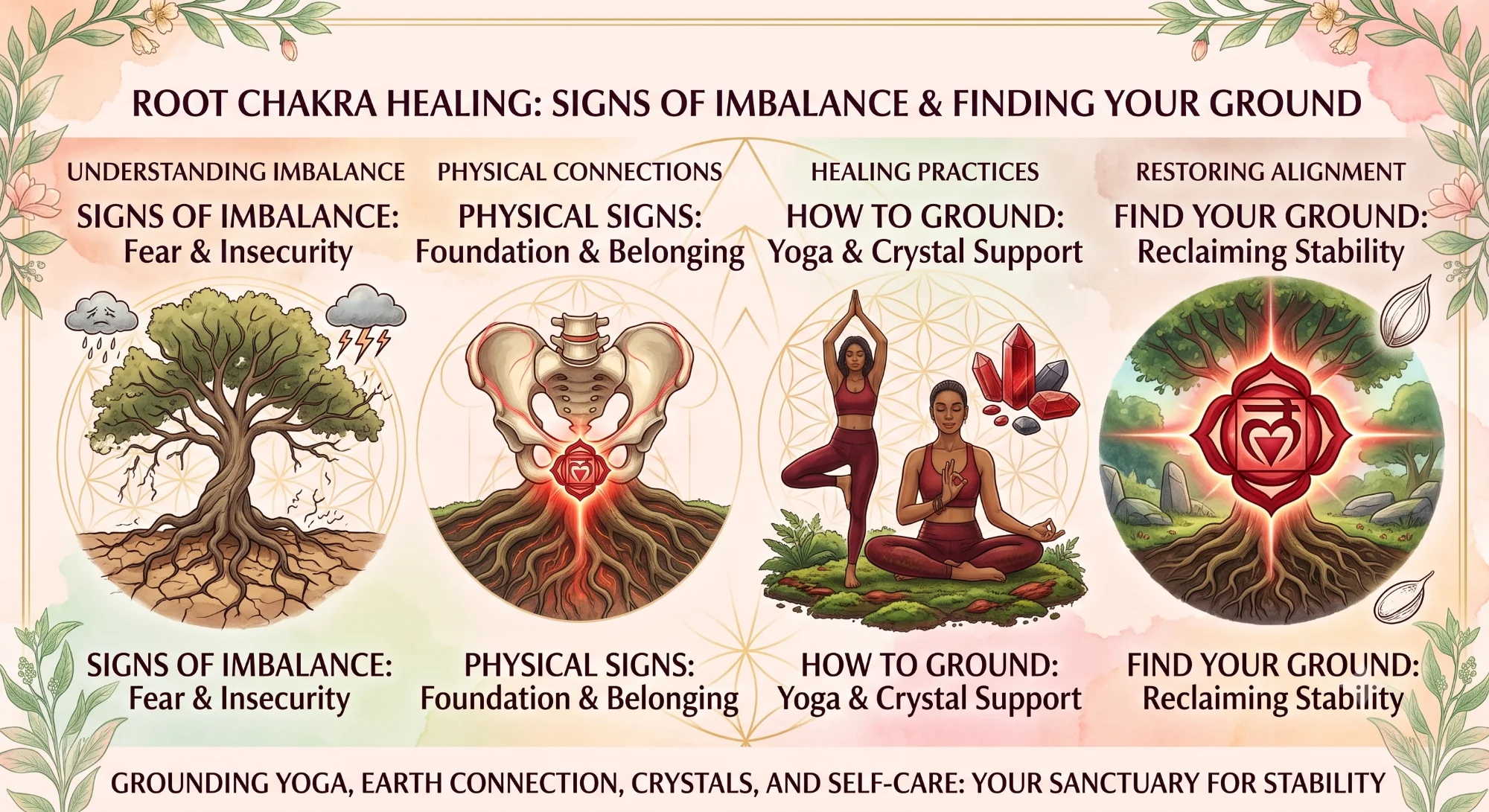
A blocked or depleted Root rarely announces itself loudly. More often, it whispers, through the body and through the emotions. Here are the signs of root chakra imbalance we see most frequently.
Physical Signs
The Root governs the base of the spine, the legs, the feet, and, importantly, the adrenal glands, which run your stress response. When this center is dysregulated, the body often holds it here:
- Chronic lower-back tension or discomfort
- Issues with the legs, knees, or feet
- Digestive sluggishness
- Persistent fatigue that sleep doesn't fully resolve
- A nervous system stuck in subtle, ongoing fight-or-flight
Emotional and Mental Signs
This is where most people first notice something is off:
- Persistent anxiety, worry, or a vague sense of dread
- Feeling ungrounded, scattered, or "not quite here"
- Financial stress that feels bigger than the numbers warrant
- Difficulty setting boundaries or feeling safe with others
- Restlessness, an inability to truly settle and rest
If several of these feel familiar, please don't read it as something wrong with you. Read it as information. Your system is signaling that it needs more safety, more grounding, more support. That's exactly what root chakra healing offers.
What Causes Root Chakra Imbalance?
Understanding the why makes the healing make sense. The Root Chakra develops primarily in our earliest years, the period when we first learn, on a deep nervous-system level, whether the world is safe. But it can be destabilized at any age. Common root causes include:
- Chronic stress and burnout, which keep the adrenals and nervous system locked in survival mode
- Major life transitions like a move, a job loss, a breakup, or a loss, all of which disrupt your sense of stability
- Financial insecurity, which strikes directly at the Root's territory of safety and "enough"
- Disconnection from the body, often a byproduct of living almost entirely in our heads and our screens
- Unprocessed fear or early experiences that taught the body to brace rather than to rest
Here's the key insight from both naturopathic medicine and energy work: these patterns don't only live in the mind. They get held in the body, in the base of the spine, the legs, the adrenals. So lasting root chakra healing has to address the body, not just our thoughts. Which is exactly where grounding practices come in.
Dr. Mansi's take: In my years of practice, the clients who feel the fastest relief are the ones who stop trying to think their way calm and start working with the body instead. The Root holds its patterns in the nervous system and the adrenals, not in your reasoning. That's why a few minutes of grounding, done daily, often outperforms hours of analysis.
Grounding Practices for Root Chakra Healing
You don't need anything elaborate. The most effective root work is simple, physical, and repeated daily. Here are the practices we return to and recommend most.
1. Get Your Bare Feet on the Earth
Spend time barefoot on grass, sand, or soil, ideally fifteen minutes a day. This practice, sometimes called "earthing," does something the Root deeply craves: it reconnects you to the literal, physical ground. Feel the texture beneath your feet. Let your weight settle. It's almost embarrassingly simple, and it works.
2. Anchor With a Grounding Oil Ritual
This is where plant medicine becomes a daily anchor. Our Rooted Soul Root Chakra oil roller is formulated specifically for this work. It blends vetiver and cedarwood in a base of organic cold-pressed castor oil, with a smooth stainless steel roller ball, and personally Energy Healed with Karuna Reiki and Reiki by Dr. Mansi.
Each ingredient is chosen with intention. Vetiver is one of the most grounding botanicals on earth; it draws your awareness out of mental overactivity and back down into the body. Cedarwood carries the steady resilience of ancient forests, supporting a felt sense of structure and safety. And the castor oil base isn't incidental. Rich in ricinoleic acid, it penetrates deeply and supports the lymphatic flow that helps move stagnant, stressed energy through and out of the body.
To use it: roll the oil over the base of your spine, the soles of your feet, and your inner wrists. Take three slow breaths and imagine thick, golden roots extending from your body deep into the center of the earth. Let your shoulders drop. Let yourself arrive. (Curious how this fits the larger picture? Our complete guide to essential oils for each chakra maps the full system.)
3. Carry Your Grounding With You
A morning ritual is powerful, but the Root often needs support all day long. This is where the Bracelet of Grounding becomes a beautiful companion. It pairs genuine red jasper and garnet, stones of stability and embodied vitality, with clear quartz and a porous lava stone. Add a drop of your Rooted Soul oil to the lava stone, and you carry that anchored, supported feeling against your pulse throughout the day. Worn together, the oil and the bracelet make a complete grounding practice.
4. Meditate on Red, Rooted Light
Sit comfortably and bring your attention to the base of your spine. Visualize a warm, glowing red light there. With each breath, imagine it growing brighter and more stable, sending roots down through the floor and deep into the earth. Even five minutes of this signals safety to your nervous system.
5. Speak Words That Anchor You
The Root responds to repetition and reassurance. Choose an affirmation and return to it daily, ideally while applying your oil:
- "I am safe in my body."
- "I am grounded, steady, and here."
- "I am supported by life."
- "My needs are always met."
6. Move in Ways That Connect You to the Ground
Grounding yoga poses are especially supportive for the Root: Mountain Pose (Tadasana), Warrior I (Virabhadrasana I), Tree Pose (Vrksasana), and Child's Pose (Balasana). Move slowly. Feel your contact with the floor. Let the practice remind your body what stability feels like.
A Foundation Worth Building
Root chakra healing isn't a destination you arrive at once and check off. It's a relationship you tend, a daily return to safety, steadiness, and presence in your own body. Some days will feel solid; others won't. Be patient with yourself. That patience is the practice.
And please hold this gently: these tools support your wellbeing and your sense of grounding, but they aren't a substitute for medical care. If you're navigating significant anxiety or physical symptoms, walk this path alongside your healthcare provider.
When your Root is strong, everything else in your life has something steady to grow from. That's the quiet power of this work.
If you're ready to begin, the Rooted Soul Root Chakra oil roller is a beautiful first step. Or explore the full chakra collection to find the energy center calling for your attention.
From all of us at Meera's Mantra, may you feel safe, steady, and at home in your own body.
This is for educational and self-care purposes only and is not medical advice. Our products support your rituals and wellbeing; they are not intended to diagnose, treat, cure, or prevent any condition.
Share this article: