Chakra Healing for Beginners: A Plain-English Guide to Where to Start
New to chakra healing? Here's what chakras actually are, how to tell which one needs attention, and a simple first practice you can start today.
Featured image coming soon
Maybe someone mentioned your "root chakra" and you nodded like you knew what that meant. Maybe you saw a rainbow diagram of a body with seven glowing circles on it and thought, that's pretty, but what am I supposed to do with it?
If that's you, you're in the right place. This is chakra healing for beginners, written the way we wish someone had explained it to us: plainly, without mysticism, without the assumption that you already believe anything.
Here's what we'll cover. What chakras actually are, in language a curious ten-year-old could follow. Why the word "blocked" is a metaphor worth taking seriously. A tour of all seven, with a quick-reference table you can scan in thirty seconds. How to figure out where you should start. And then a genuinely simple first practice, seven days long, that costs you about three minutes a morning.
No prior experience required. No belief required either, honestly. Just curiosity and a willingness to pay attention to your own body.
What Are Chakras, Really?
Let's strip this down.
The word chakra is Sanskrit for "wheel." The concept comes from ancient Indian spiritual traditions, where practitioners mapped seven main energy centers running along the midline of the body, from the base of the spine to the top of the head. Not organs. Not anything you'd find on an MRI. Think of them less as physical objects and more as a map of human experience, drawn by people who paid extraordinarily close attention to what it feels like to be alive in a body.
Each of the seven governs a distinct territory:
- Root governs safety. Do I have enough? Am I okay?
- Sacral governs creativity, pleasure, and emotional flow.
- Solar Plexus governs confidence and personal power.
- Heart governs love, connection, and forgiveness.
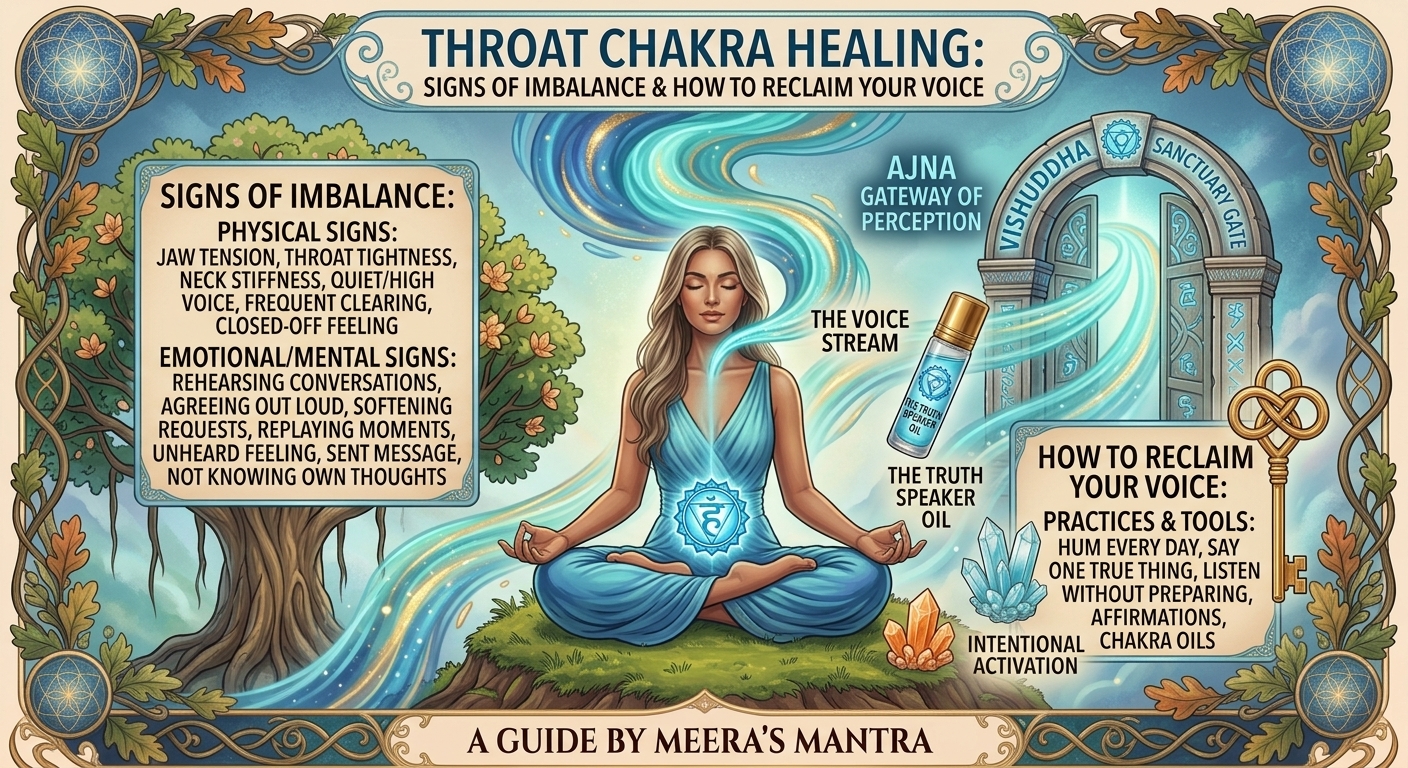
- Throat governs your voice and your truth.
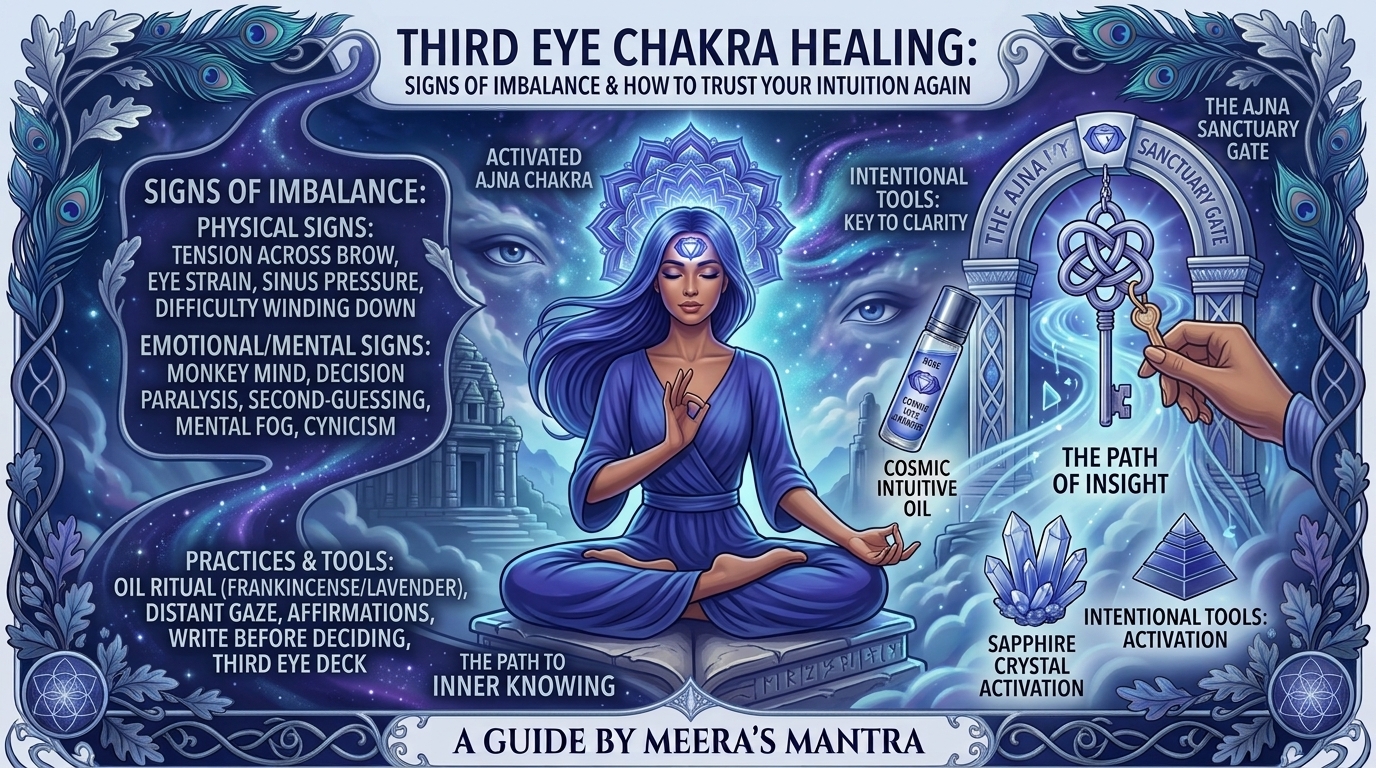
- Third Eye governs intuition and clarity.
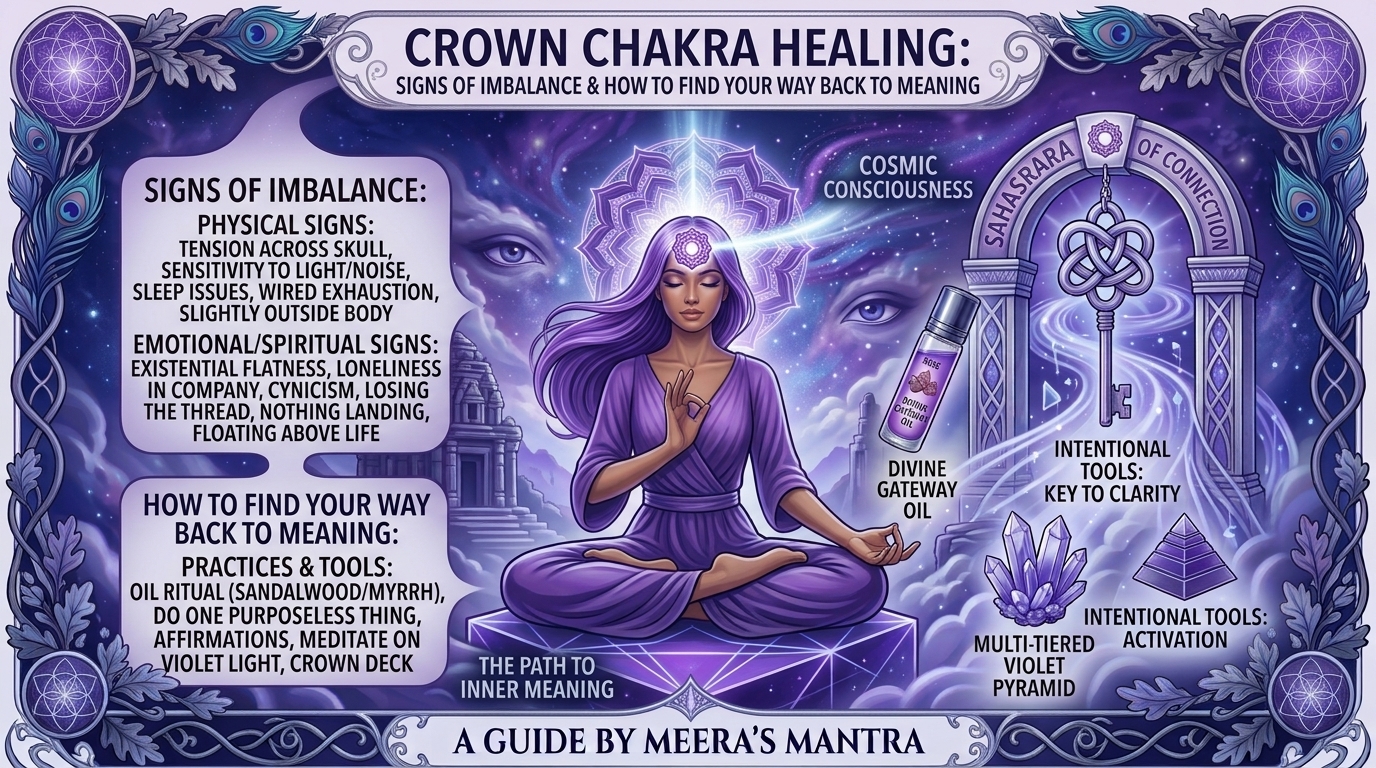
- Crown governs meaning and spiritual connection.
Read that list again and notice something. That's not a mystical taxonomy. That's a pretty complete inventory of what human beings struggle with. Safety, creativity, confidence, love, voice, clarity, meaning. Ancient practitioners didn't invent those categories out of thin air. They observed them, over centuries, and gave them a structure.
That structure is what the chakra system offers you. Not magic. A map. A way to take a vague, unnameable feeling of "something's off" and locate it: ah, this is a safety thing. Or: this is a voice thing, I've been swallowing my words for a month. Naming it is the beginning of working with it.
The chakras also stack in a meaningful order. The lower three are about your life in the physical world, the upper three are about your inner and spiritual life, and the Heart is the bridge between them. This matters more than it might seem, and we'll come back to it when we talk about where to begin.
Why "Blocked" Is a Metaphor Worth Taking Seriously
You'll hear people say a chakra is "blocked." That word makes some people wince, and we understand why. It sounds like plumbing for the soul.
But sit with it, because the metaphor is doing real work.
Think about what happens when you've been under sustained stress. Your shoulders creep toward your ears. Your breath gets shallow and stays there. Your jaw clenches at night. You didn't decide any of that. Your body made those choices for you and then kept making them, long after the stressful thing was over. The pattern got stuck.
That's a block. Something started flowing, then stopped, then stayed stopped.
Now consider that the same thing happens emotionally. A person who was criticized every time they spoke up as a child learns to keep quiet. Twenty years later, they still feel a tightening in their throat before saying something honest in a meeting. That's not a decision either. That's a pattern that got held, in the body, in the nervous system, in the exact place the ancient traditions mapped as the Throat.
Here's what strikes us most, and what our founder, Dr. Mansi Vira, a Naturopathic Doctor, Reiki Master, and Karuna Reiki Practitioner, has seen again and again across years of practice: those old maps and modern nervous-system science keep landing in the same places. The Root is associated with the adrenal glands, which run your stress response, and Root imbalance shows up as anxiety. The Solar Plexus is associated with digestion, and self-doubt famously lives in your stomach. The Throat is associated with the thyroid and the jaw, and unspoken words really do sit there as tension.
You don't have to decide whether energy is literal or metaphorical to benefit from this. You just have to accept that patterns get held in the body, that where they're held is not random, and that working with the body, rather than only thinking about the problem, is often what shifts them.
That's chakra healing. It's less exotic than it sounds and more useful than you'd expect.
The Seven Chakras: A Quick Tour
Here's the whole map in one place. Scan the "signs it's asking for attention" column and notice which row makes you go, oh. That reaction is information. Trust it.
| Chakra | What it governs | Signs it's asking for attention | Go deeper |
|---|---|---|---|
| Root (Muladhara), base of spine | Safety, stability, belonging, your basic sense of "I'm okay" | Persistent anxiety, feeling scattered or unmoored, money worry that outsizes the numbers, low-back tension, fatigue sleep doesn't fix | Root chakra healing guide |
| Sacral (Svadhisthana), below the navel | Creativity, pleasure, emotional flow, desire | Creative blocks, emotional numbness or volatility, guilt about rest and joy, tight hips, life feeling gray | Sacral chakra healing guide |
| Solar Plexus (Manipura), upper abdomen | Confidence, willpower, self-trust, decisions | Second-guessing everything, people-pleasing, feeling powerless, digestive upset, that foggy "I don't trust myself" feeling | Solar plexus chakra healing guide |
| Heart (Anahata), center of the chest | Love, compassion, forgiveness, connection | Walls up, old grief or resentment you can't set down, loneliness, harsh self-criticism, shallow breathing | Heart chakra healing guide |
| Throat (Vishuddha), throat and neck | Voice, truth, authentic expression | Swallowing your words to keep the peace, fear of judgment, tight jaw, feeling unheard, a gap between what you feel and what you say | Throat chakra healing guide |
| Third Eye (Ajna), between the brows | Intuition, insight, mental clarity | Overthinking, monkey mind, brain fog, indecision, can't hear your own gut over the noise | Third eye chakra healing guide |
| Crown (Sahasrara), top of the head | Meaning, purpose, spiritual connection | Feeling disconnected or quietly empty, striving without rest, "is this it?", trouble settling into stillness | Crown chakra healing guide |
A word of reassurance, because this is where beginners often spiral: most people read that table and recognize themselves in four or five rows. That is completely normal. It does not mean you're a wreck. It means you're a person with a full life, and the chakras are interconnected, so strain in one place creates strain in another. You don't need to fix all seven. You need to start with one.
How to Tell Where to Start (Hint: It's Usually the Root)
So, which one?
Here's the beginner's shortcut, and it's the one we'd give almost anyone walking through our door for the first time: start at the Root.
Not because the Root is the most important chakra, but because of that stacking order we mentioned. The Root is the foundation. Everything else is built on top of it. When your nervous system is running a low, constant hum of I'm not safe, it is extraordinarily hard to be creative, or confident, or open-hearted, or intuitive. Your system has other priorities. It's busy scanning for threats.
Try to work on your Third Eye intuition while your Root is unsettled and you'll feel like you're pushing a rock uphill. Settle the Root first and you'll often find that two or three of the other rows in that table quiet down on their own, without you doing anything about them directly. This is one of the most common surprises people report, and it's why we keep saying: build the floor before you hang the art.
There are two good reasons to start somewhere else.
One: something is unmistakably loud. If you read the Throat row and felt an actual physical tightening, if you've spent the last year not saying the thing you needed to say, then go there. Your body is being direct with you. Don't argue with it.
Two: you've done Root work before and it's solid. If you genuinely feel safe and steady in your body, wonderful. Move up the stack to whatever's next.
Otherwise? Root. Start with our full guide to root chakra healing and the signs of imbalance, and let everything else wait.
Dr. Mansi's take: I almost always begin clients at the Root, even the ones who arrive convinced their problem is somewhere else entirely. When someone's nervous system finally believes it's safe, half of what they came in worried about tends to soften on its own. It's not that the other chakras don't matter. It's that they can't do their work standing on unstable ground.
Your First Seven Days
Here's the whole practice. It takes about three minutes. Read it once and you'll have it.
Pick one chakra. Probably the Root. One. Not three, not all seven. One.
Then, every morning for seven days:
- Sit down and put a hand on the chakra's location. For the Root, that's low on your belly or the base of your spine, whatever you can comfortably reach. Physical contact matters more than you'd think; it tells your body where to send its attention.
- Take three slow breaths. In through the nose, out longer than in. That longer exhale is the part that signals your nervous system to stand down. It's not a trick—it's how the system is wired.
- Say one sentence, either out loud or silently. For the Root: "I am safe in my body." For the Sacral: "It is safe to feel." Solar Plexus: "I trust myself." Heart: "It is safe to soften." Throat: "My voice matters." Third Eye: "I trust what I know." Crown: "I am part of something larger." Pick one and use the same one all week. Repetition is the whole point.
- Notice one thing. Just one. Are your shoulders lower than they were a minute ago? Is your jaw looser? Did nothing happen at all? All of those are valid observations. You're building the skill of noticing, which is the actual foundation of every practice that follows.
That's it. That's the entire thing.
We're aware this looks almost insultingly simple. It's supposed to. The single biggest mistake beginners make is designing an elaborate forty-minute ritual, doing it beautifully twice, and then never doing it again. A three-minute practice you actually keep will out-perform a perfect practice you abandon by Thursday. Every time.
If you want one thing to add on day eight, add movement. Walk barefoot on grass for the Root. Sway your hips for the Sacral. Take up more space than you're comfortable with for the Solar Plexus. The body responds to the body.
Where the Tools Fit
You can do everything above with nothing but your hands and your breath. Please hear that clearly. We sell chakra tools, and we still want you to know that the practice comes first and the tools come second.
So what are they for? Anchoring. Habits stick when they have a physical cue—a scent, an object, a small ceremony that tells your brain we're doing the thing now. That's the honest, unglamorous reason ritual objects have existed in every human culture. They make the invisible repeatable.
Here's how our three fit together, and what each one is actually doing.
Oil rollers are the morning anchor. Each 10ml roller pairs chakra-specific essential oils with an organic cold-pressed castor oil base. We chose castor oil deliberately: it's roughly 90% ricinoleic acid, a rare fatty acid that lets it penetrate more deeply than lighter carriers, carrying the essential oils with it, and it naturally supports lymphatic flow. It applies through a smooth stainless steel roller ball, so it's clean and even. And every batch is Energy Healed with Karuna Reiki and Reiki by Dr. Mansi. There's one for each center: The Rooted Soul for the Root, The Creator for the Sacral, The Power Source for the Solar Plexus, The Love Alchemist for the Heart, The Truth Speaker for the Throat, The Cosmic Intuitive for the Third Eye, and The Divine Gateway for the Crown. If you're not sure which, the full 7 chakra oil set covers the whole map.
The scent is doing something real here, by the way. Aromatic molecules travel to the olfactory bulb, which wires directly into the limbic system, the emotional and memory center of your brain. Use one scent for one intention, daily, and within a week that smell becomes the intention. Your nervous system does the filing for you.
Bracelets carry the practice past the morning. Each pairs two chakra crystals with clear quartz and a porous lava stone: Grounding with red jasper and garnet, Creation with carnelian and tiger's eye, Empowerment with pyrite and citrine, Harmony with rose quartz and green aventurine, Divine Truth with blue lace agate and aquamarine, Insight with lapis lazuli and sodalite, and Connection with amethyst and fluorite. Add a drop from your roller to the lava stone and the scent travels with you. The practical magic is simpler than the stones, though: it's on your wrist, so you see it, so you remember.
Cards give you the words. Most beginners stall out at "what am I supposed to say?" The chakra card deck answers that with affirmations and reflection prompts, so you're not staring at the ceiling improvising. If you'd like one chakra covered from every angle, the chakra collections group the pieces together.
Start with one thing. Add later, if you want to. The full shop will still be there.
What to Honestly Expect
We'd rather be straight with you than sell you a fantasy.
Healing is not linear. You'll have a week where you feel genuinely settled and then a Tuesday that undoes it. That's not failure—that's the shape of the thing. Progress in this work looks like a jagged line trending gently upward, not a ramp.
It's cumulative, not instant. Some people feel something the first morning, usually from the breathing and the scent. Most people notice the real shift around week three, and often in retrospect: huh, I haven't felt that particular dread in a while. Quiet, not dramatic.
Nothing gets deleted. Root work doesn't erase anxiety forever. It gives you a reliable way back to steady when anxiety shows up. That's a practice, not a fix, and honestly, a practice is the better deal. Fixes break.
This isn't medical care. These are tools for wellbeing and ritual, and they sit alongside your healthcare provider, not instead of them. If you're navigating something significant, physically or emotionally, please walk this path with real support beside you.
Where to Go Next
You now know more about chakras than most people who use the word.
Three good next steps, in order.
Read your chakra's deep dive. Whichever row in that table made you pause, go read it. The Root, Sacral, Solar Plexus, Heart, Throat, Third Eye, and Crown each have their own guide, with the causes, the signs, and the practices that help.
Learn the plant side. Our companion pillar on essential oils for each chakra maps which botanicals support which center and why. When you're ready to actually use them, how to use chakra oils walks through application.
Do tomorrow morning's three minutes. Truly, this is the one that matters. Everything else is reading.
You don't need years of training or a shelf full of supplies to begin. You need one energy center, one sentence, and the willingness to come back tomorrow.
From all of us at Meera's Mantra, welcome. May you begin exactly where you are, and be gentle with what you find.
This is for educational and self-care purposes only and is not medical advice. Our products support your rituals and wellbeing; they are not intended to diagnose, treat, cure, or prevent any condition.
Tags:
Share this article: