Heart Chakra Healing: Signs of Imbalance and How to Open Again
A guide to heart chakra healing: the signs of a blocked Anahata, what closes the heart in the first place, and gentle practices to soften and reopen.
There's a particular kind of loneliness that has nothing to do with being alone. You can be at a table full of people who love you, laughing at the right moments, saying the right things, and still feel like there's a pane of glass between you and the room. You're present. You're just not quite reachable.
Or maybe it shows up in your body first. A tightness across the chest that you've stopped noticing because it's been there so long. Shoulders that curl forward without being asked. A breath that only ever fills the top third of your lungs. If any of that lands, your Heart Chakra may be asking for your attention, and heart chakra healing is some of the tenderest, most worthwhile work you'll ever do.
Here's what we want you to know before we go any further: a closed heart is not a broken one. It's a protected one. Let's walk through what the Heart Chakra is, how to recognize when it's out of balance, what tends to close it, and the practices that help it soften again.
What Is the Heart Chakra?
The Heart Chakra, known in Sanskrit as Anahata, sits at the center of your chest. The name translates to something like "unstruck" or "unhurt," and that meaning is worth sitting with for a moment. Ancient teachers named this center after the part of you that remains whole no matter what has happened to you. Not the part that was never hurt. The part that was never ruined.
Anahata is the fourth of your seven main energy centers, and its position matters enormously. Three chakras sit below it, governing safety, creativity, and personal will, the territory of the body and the self. Three sit above it, governing voice, insight, and spirit. The Heart is the bridge. Every piece of energy moving from your body up toward your voice or your intuition has to pass through your chest. When that passage is narrow, everything above and below it feels the constriction.
It's associated with the element of air and with the color green, softened with rose pink. Air is a fitting element for it: open, moving, impossible to grip.
When your Heart Chakra is balanced, it feels like this:
- You give and receive love without keeping score
- You can be close to people without bracing for the moment it goes wrong
- Forgiveness comes more easily, for others and for yourself
- You feel genuine compassion rather than obligation
- Your chest feels roomy, and your breath goes all the way down
One honest note before we continue. The Heart opens most easily when the ground underneath it feels solid. If safety itself is shaky, the chest tends to stay guarded no matter how much you work on it directly, which is why we often suggest starting with root chakra healing and letting the Heart follow. If you'd like to see how all seven centers relate, our guide to essential oils for each chakra maps the full system.
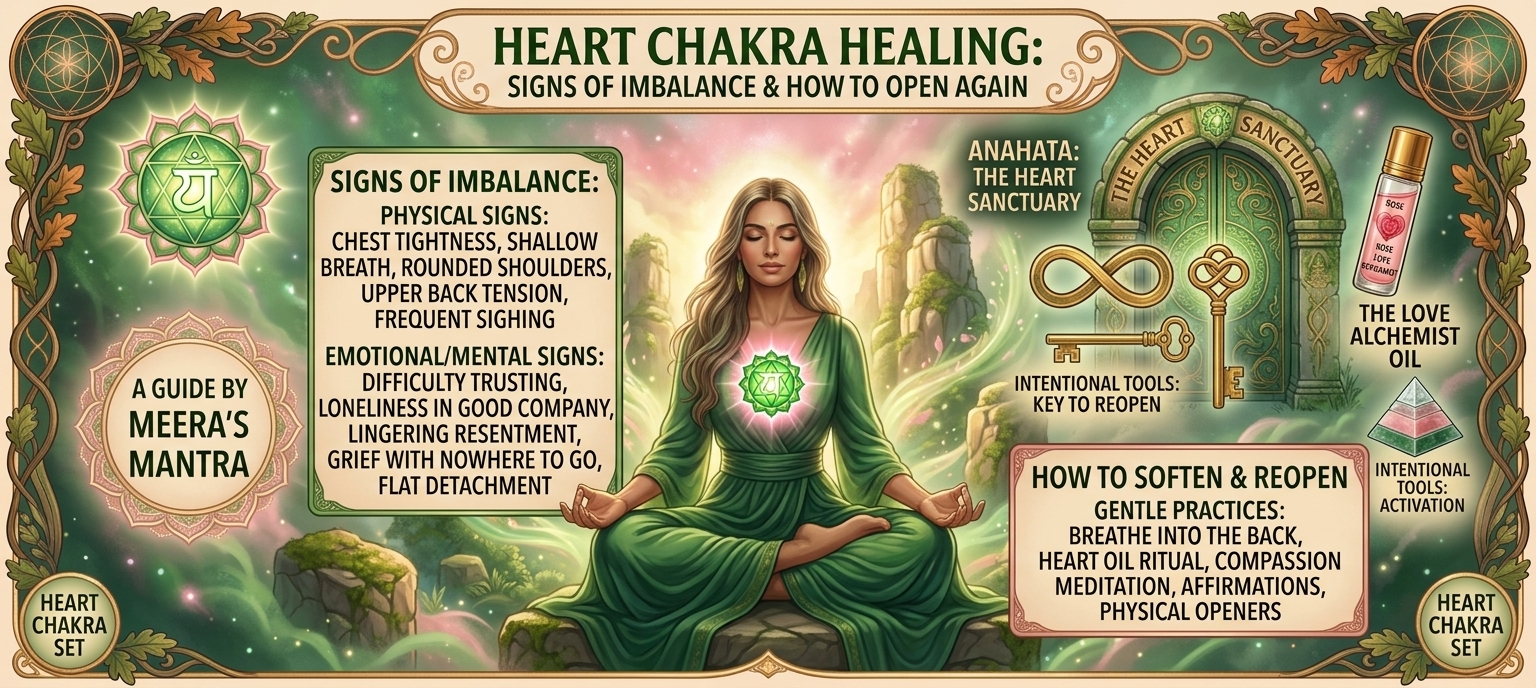
Signs of Heart Chakra Imbalance
A blocked Heart Chakra is remarkably good at hiding. It rarely looks like collapse. More often it looks like competence, like being the person everyone relies on, like being fine. Here are the signs of heart chakra imbalance we hear about most often.
Physical Signs
Anahata governs the chest, the lungs, the arms, and the upper back. When this center is guarded, the body tends to organize itself around the guarding:
- Persistent tightness or a gripped feeling across the chest
- Shallow breathing that never quite reaches the belly
- Shoulders that round forward, a chest that quietly caves
- Tension banded across the upper back, between the shoulder blades
- Frequent sighing, or catching yourself holding your breath
- Arms that feel heavy, or a reluctance to reach out with them
Notice that these are postures of protection. Your body is doing exactly what a body does when it wants to shield something soft.
Emotional and Mental Signs
This is usually where people first sense that something has closed:
- Difficulty trusting, even people who have given you no reason to doubt them
- Loneliness in the middle of good company
- Resentment that lingers long past the event that caused it
- Grief with nowhere to go, that surfaces at odd, inconvenient moments
- A running commentary of self-criticism you'd never aim at a friend
- Over-giving, staying useful, making yourself indispensable so no one leaves
- A flat, pleasant detachment where feeling used to be
If several of those feel familiar, please don't read it as a verdict on you. Read it as information. Your system is telling you where it decided, at some point, that closing was safer than staying open. That decision made sense when you made it.
What Causes a Blocked Heart Chakra?
Almost every blocked heart chakra we encounter has an origin story, and it's usually not a character flaw. It's a reasonable response to something that genuinely hurt.
- Grief. Loss doesn't stay in the mind. It settles into the chest, and when there's no room or time to move through it, the body holds it there for you, indefinitely, at cost.
- Heartbreak and betrayal. When love and pain arrive from the same source, the nervous system learns to treat closeness itself as a warning sign.
- Caregiving depletion. If you've spent years pouring out, the Heart can start rationing. Not from selfishness. From a genuinely empty reservoir.
- Early lessons about softness. Many of us learned young that needing too much, or feeling too loudly, made us a problem. The chest remembers that lesson long after the mind has moved on.
- Self-protection that outlived its usefulness. This is the big one, and it deserves its own paragraph.
Here's the reframe we come back to again and again. Your heart didn't close because something is wrong with you. It closed because closing worked. It kept you functional through something difficult, and it did its job well. The trouble is that nobody ever came along afterward and told it the danger had passed. So it's still standing guard at a door that no longer needs guarding—years later, faithfully, exhaustingly.
You don't heal that by force. You can't argue a heart open, and trying usually makes it grip harder. What actually works is showing it, slowly and repeatedly, that it's safe to loosen. And since the guarding lives in the body, in the chest and the breath and the shoulders, that's where the work happens.
Dr. Mansi's take: In my practice, the people who struggle most with heart work are usually the ones treating their own closed heart as a failure to fix. I'd invite you to try something different: thank it. That protection carried you through something real, and it deserves gratitude before it deserves change. In my experience, a heart that feels appreciated softens far more willingly than one that feels criticized.
Practices to Soften and Reopen the Heart
None of this is elaborate. The Heart doesn't respond to intensity. It responds to consistency, and to being approached gently.
1. Put a Hand on Your Chest and Breathe Into Your Back
Sit down. Rest one hand over the center of your chest, with enough weight that you can feel it. Now breathe, and aim the breath toward your upper back rather than your front. Feel the ribs widen behind you.
This sounds almost too small to matter. It isn't. Touch over the heart center plus slow, directed breathing is one of the fastest ways to tell your nervous system that nothing is currently coming for you. Two minutes is enough to start.
2. Anchor the Practice With a Heart Oil Ritual
This is where a daily ritual gives the work somewhere to live. The Love Alchemist is our Heart Chakra oil roller, physician formulated by our founder, Dr. Mansi Vira, a Naturopathic Doctor, Reiki Master, and Karuna Reiki Practitioner, and Energy Healed with Karuna Reiki and Reiki by her hands.
It blends rose and bergamot in a base of organic cold-pressed castor oil, delivered through a smooth stainless steel roller ball. Every part of that is deliberate.
Rose has been the plant of the heart across nearly every healing tradition that ever encountered it. It soothes the nervous system and invites self-compassion, which is precisely the quality most of us are shortest on. Bergamot brings brightness. Where rose softens, bergamot lifts—it's emotionally regulating in a way that keeps heart work from tipping into heaviness. Together they're tender without being sad.
And the castor oil base isn't a filler. It's roughly 90% ricinoleic acid, which is why it penetrates so deeply rather than sitting on the surface. It supports lymphatic flow, and it carries the essential oils further in than a lighter carrier would. When you're working with a chest that has been holding something for a long time, that depth matters.
To use it: roll the oil over the center of your chest, along your collarbones, the insides of your wrists, and the creases of your elbows. Then put your palm over your sternum and take three unhurried breaths. Let the scent arrive before you ask anything of yourself. That's the whole practice. (For where this sits in the wider system, our complete guide to essential oils for each chakra walks through all seven.)
3. Carry It Through the Day
Mornings are a good start, but the chest tends to re-grip somewhere around the third difficult email. The Bracelet of Harmony is made for the rest of the day. It strings genuine rose quartz and green aventurine, the stones most associated with self-compassion and heart-opening, alongside clear quartz and a porous lava stone. Add a drop of your Love Alchemist oil to the lava stone and the scent travels with you, right at your pulse. If you'd like both pieces together, they come paired in The Love Alchemist Collection.
4. Meditate on Green Light in the Center of Your Chest
Sit comfortably. Bring your attention to your sternum and picture a soft green light there, about the size of your palm. On each inhale, let it brighten. On each exhale, let it widen, past your ribs, past your shoulders, filling the room you're in.
If it doesn't want to expand, don't push. Just notice, kindly, that it isn't ready today. Noticing without forcing is the practice.
5. Give the Heart Some Words
The Heart responds to being spoken to gently and often. Pair an affirmation with your oil ritual and let the two become one habit:
- "I am safe to feel this."
- "I can be open and protected at the same time."
- "I give myself the compassion I give everyone else."
- "My heart knows how to open. I don't have to force it."
If finding your own words feels difficult, and it often does at first, The Love Alchemist: Heart Chakra Mini Deck offers prompts and affirmations to start from. Sometimes borrowing the language is what lets you find your own.
6. Open the Chest Physically
The body's shape and the heart's state are in constant conversation, and you can enter that conversation from either side. Gentle heart-openers ask the chest to unfold without demanding anything dramatic: Sphinx Pose, a supported Fish over a rolled blanket, slow Cow Pose, or simply standing in a doorway with your forearms on the frame and letting your chest drift forward.
Stay long enough to breathe. The point isn't the stretch. The point is spending a few honest minutes in a shape that isn't bracing.
The Heart Opens on Its Own Schedule
Heart chakra healing doesn't move in a straight line, and anyone who promises otherwise isn't being honest with you. You'll have a week where your chest feels roomy and you laugh more easily, and then something will land wrong and you'll feel the old shields come up in an instant. That's not a relapse. That's a system doing its job, and it's part of how this goes.
Softening also doesn't mean leaving yourself unguarded. An open heart isn't one without boundaries—it's one that gets to choose, rather than defaulting to closed. Discernment is heart work too.
Please hold this gently as well: these practices support your wellbeing and your relationship with your own heart, and they aren't a substitute for care. If you're carrying grief that feels too heavy to hold, or any physical symptom in your chest that concerns you, please walk this path alongside a healthcare provider you trust. There's no strength in doing it alone.
Anahata means unstruck. Whatever has happened to you, there's a part of you it never reached. That's the part we're tending here.
If you'd like to begin, The Love Alchemist is a gentle first step. Or explore the full chakra collection and see which center is asking for you.
From all of us at Meera's Mantra, may your heart find its way back to open, in its own time.
This is for educational and self-care purposes only and is not medical advice. Our products support your rituals and wellbeing; they are not intended to diagnose, treat, cure, or prevent any condition.
Share this article: